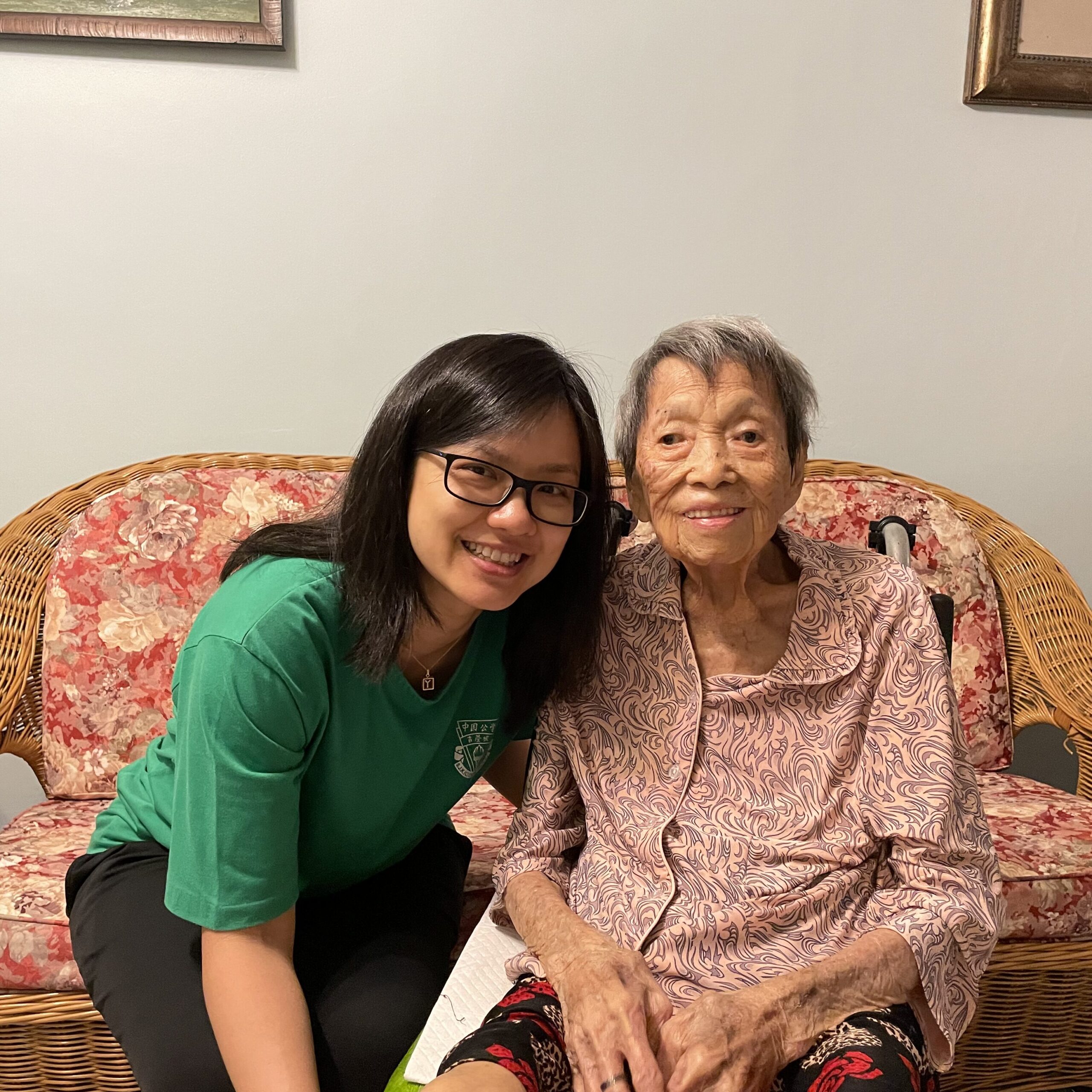
I woke up at 3 am thinking about the 93-year old lady whom I discharged the evening prior, wondering if she’s doing okay.
Popo G (‘Popo’ means grandmother in Chinese) has a blue cap on her head, covering her face, shielding her from the bright fluorescent light of the exam room in the ER. Her family brought her to the ER because she’s been complaining of right-sided back pain since she fell off her bed the day before. She stares at me blankly when I greet her in her native tongue, Cantonese. Her daughter at bedside tells me she’s very hard of hearing, which explains her lack of reaction. In hindsight, I wonder if her stoned expression and subdued manner was because of the oxycodone she was given earlier. As I get to learn more about her later, her personality is nothing like this calm, subdued woman sitting in front of me, and she is able to hear me and others well enough to yell back with full strength. At that moment though, that isn’t what happens. I try hard to communicate with her, both yelling next to her ears, as well as using the tele interpreter on max volume, but all she does is stare at us with a blank expression. It’s as if there is a 6-inch fiberglass wall surrounding her, blocking out all sounds. All she says to us is, “I’m deaf!”
Popo G’s fall resulted in three consecutive rib fractures on the right side. Thankfully, there is no pneumothorax or flail chest, and nothing else was broken or ruptured. She was referred to me for an admission, mainly for pain control, and a physical therapy consult to ensure she’s safe enough to be discharged home, or if not, to go to a rehab for a short stay. It’s a straightforward enough case, and I admitted Popo after my failed attempt to communicate with her. I never thought that 3 hours later, I’d suffer the wrath from her for the plan to admit her to the hospital without her permission.
I get a message from her nurse Q, who informs me that “patient is threatening to jump out of the window if we try to keep her in the hospital”. I’m surprised by this, given that no matter how loud I yelled next to her ears earlier, she didn’t seem to respond or acknowledge that she heard me. How is it then, that she’s now able to express such threat? Q says they use the help of the tele interpreter to communicate with her. I’m intrigued, and I have to see for myself, this drastic transformation of character from hours ago. When I get to the bedside, this thin-framed but not-frail nonagenarian is sitting at the edge of the chair next to her bed, with her two daughters and a son-in-law at bedside, the tele interpreter, and her nurse next to them. Popo G seems to be in a fight-or-flight mode, or maybe just in a fight mode, and when our eyes meet, I feel the burn all the way through my eyes into the back of my skull. I’m both intimidated and amused at the same time. She reminds me of my own grandma.
What happens after is a long multi-way conversation and negotiation between this sprightly woman, her grandson who is a psychiatry resident out-of-state (on the phone), her family at bedside, the tele interpreter, the nurse, and myself. Popo wants to go home; she insists that the pain is nothing unbearable; she’s never been sick her whole life – and she reminds us she’s been around for almost a century – why are we trying to keep her in the hospital now, and how dare we make that decision for her without her permission! Family members seem to be okay with whatever decision I make for her, which aggravates Popo even more. Grandson says if I think Popo is safe for discharge, he’s okay with that, to which I tell him, to the extent of her three non-displaced fractures without other complications, she’s stable for discharge. That said, as is for any elderly patient who lives alone, there will always be some safety concerns given their high fall risk. Nurse Q on the other hand feels patient should stay, because she hasn’t been evaluated by PT, and thus is very unsafe to be sent home just like this. She adds that patient may need to be evaluated by psych given her threats to jump out of the window.
While it’s not wrong that there are some risks in sending nonagenarians like Popo G home after a fall, the risk of recurrent falls won’t change or abate whether we send her home today or the next day. In this case, she’s able to ambulate independently, her internal organs are intact, she tells us her pain is tolerable. She’s also shown us that she won’t give in without putting up a fight if we insist to keep her. First, there’s the question of whether it’s ethical to keep her against her wishes. One cannot assume the lack of decision-making capacity just because a person is old. Old in age does not equate senility. Even if we manage to convince her to stay, are we sure we’re helping her and won’t cause more harm to her? How many times have we seen unnecessary admissions for benign diagnoses such as constipation or simple urinary tract infection in elderly that was supposed to be kept overnight observation that turned into a long drawn out admission due to hospital-related complications?! Lastly, the threat that Popo G verbalizes? Should we take it seriously verbatim or is it her way of expressing her anger and frustration for having her freedom of choice taken away from her? Here is a woman who feels she’s about to lose her dignity and independence the moment she allows us to keep her in the hospital. She’s making her last pitch to fight for her freedom.
After discussion with her family, I ask her daughters to take turn sleeping over at Popo G’s house for the next few days just to keep a watch on her, which they gladly agree to do. The son-in-law will also work on lowering her bed and get her a walker in case she needs it. I send her home with some pain meds in case she truly is in pain and needs it, but emphasize to her the side effects, and to use it with caution. I tell them what to look out for, and to come back to the hospital if she has any new symptoms or worsening pain. Everyone seems to be happy and agreeable to the plan, everyone except Nurse Q. From the corner of my eye, I saw her slight dismay, and her sarcastic manner when speaking to me tells me she’s not at all convinced this is the right course of action. Too bad, I thought to self, I can’t please everyone.
The rest of my shift went by uneventfully, I got home and went to bed. Didn’t think much of it after Popo G and her family left. And so, it comes as a surprise to myself when I jolted up in the middle of the night thinking about this incident. Somehow Nurse Q’s response bothered me. I find myself wondering whether I did right by my patient. Have I been careless to send Popo home? Will she be okay at home? What if she suffers another fall, and this time break another bone? Should I have made sure she stayed the night and have physical therapy evaluate her before sending her home?
No matter how I think about this, I still arrive at the same decision. I just regret that I wasn’t able to convince the nurse to be onboard with the decision. I hope Popo G heals well from her rib fractures, and that she lives a long, long life without any fall or hospital encounter. I know she will be alright. Her sassiness and feisty self will keep her going for a long time.
As I drift back to sleep, I think of my own grandma. How I wish she was around a little longer.